
By Dennis Cassinelli
2018 is the 150th anniversary of the Central Pacific railroad reaching Reno, Nevada. From Reno, the track was laid across the entire state and connected the towns of Verdi, Reno, Sparks, Winnemucca, Battle Mountain, Carlin, Elko, Wells and Wendover.
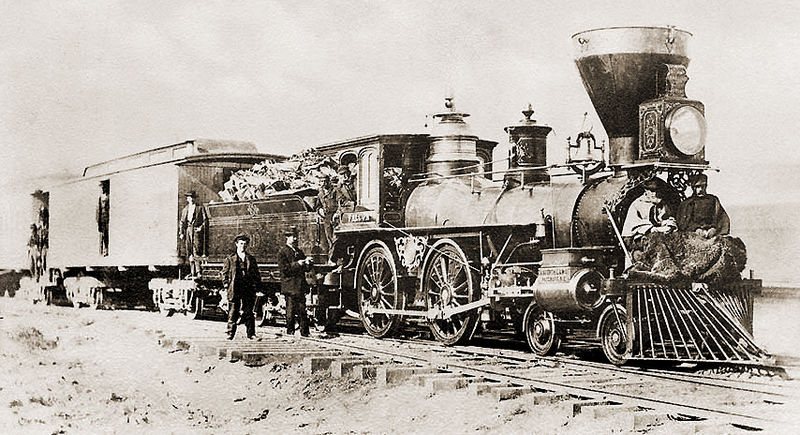
By John B. Silvis (UPRR photographer) (1830-1900) [Public domain], via Wikimedia Commons
Being a construction person, I cannot help but admire what was accomplished by the people who constructed the Central Pacific Railroad across Nevada between April 1868 and May 1869. Without heavy construction equipment, these men built a railroad that crossed the entire expanse of the State of Nevada in little over one year. The roadbed was flat and smooth, and the grading was done by Chinese laborers using wheelbarrows and shovels. The roadbed was built up by taking material from a “borrow ditch” on either side and throwing soil up onto the roadbed. In a hill or cut section, the material was thrown up over the side and not hauled long distances as it is in modern construction.
The route selected for the Central Pacific Railroad through the mountains and deserts of Nevada generally followed the Old California Trail, since this had been proven the easiest route of travel through the Great Basin for many years. Since the railroad need water for the steam engines, the route had to be near access to water at regular intervals.
The original roadbed didn’t even have ballast between the ties in many areas. This was added later when the line was completed and ballast material could be brought in on railroad cars.
At the Nevada State Railroad Museum, I picked up a remarkable book titled The Central Pacific Railroad Across Nevada, 1868 & 1997 by Lawrence K. Hersh. The Central Pacific Company employed an official photographer named Alfred A. Hart who took photos along the way during construction through Nevada.
In Hersh’s book he shows many of these photos along with photos he has taken from the same locations showing, by way of comparison, how these same places look today. This is truly a fascinating volume, and I recommend it to anyone interested in railroad history. While working for years on construction projects along Interstate 80, I made a game of visiting many of these same places to see firsthand what traces of the old Central Pacific could still be found.
So far, I have found several railroad spikes, a broken brake shoe, some track plates and a remarkable cover plate from a journal box with the inscription “C.P.R.R. -1875.” At the end of the construction season, I took my box of rusty iron over to the Nevada State Railroad Museum to see if they wanted any of this memorabilia from the Nevada portion of America’s first transcontinental railroad. They said, “thanks” but they already had enough rusty iron from the CPRR. As I drive along Interstate 80 across Nevada, I can point out many traces of the original roadbed.
The driving of the golden spike in 1869 near Promontory Point, Utah celebrated an intense year of construction of the Central Pacific Railroad through the mountains and deserts of the Great Basin known as Nevada. Several vintage Locomotives from the Nevada State Railroad Museum participated in the centennial of this event.
Immediately after the completion of the Central Pacific, between 1,600 and 2,000 men from that project went to work on the Virginia and Truckee Railroad. The majority of these were Chinese laborers at a time when the population of Virginia City was about 10,000. The permanent residents were interested in mining and other occupations, and they were content to leave the railroad building to the Chinese.
This article is by Dayton Author and Historian, Dennis Cassinelli, who can be contacted on his blog atdenniscassinelli.com. All Dennis’ books sold through this publication will be at a 50% discount plus $3.00 for each shipment for postage and packaging.
Leave a Reply